
What Is the Difference Between Claude Code and HighLevel AI Studio?
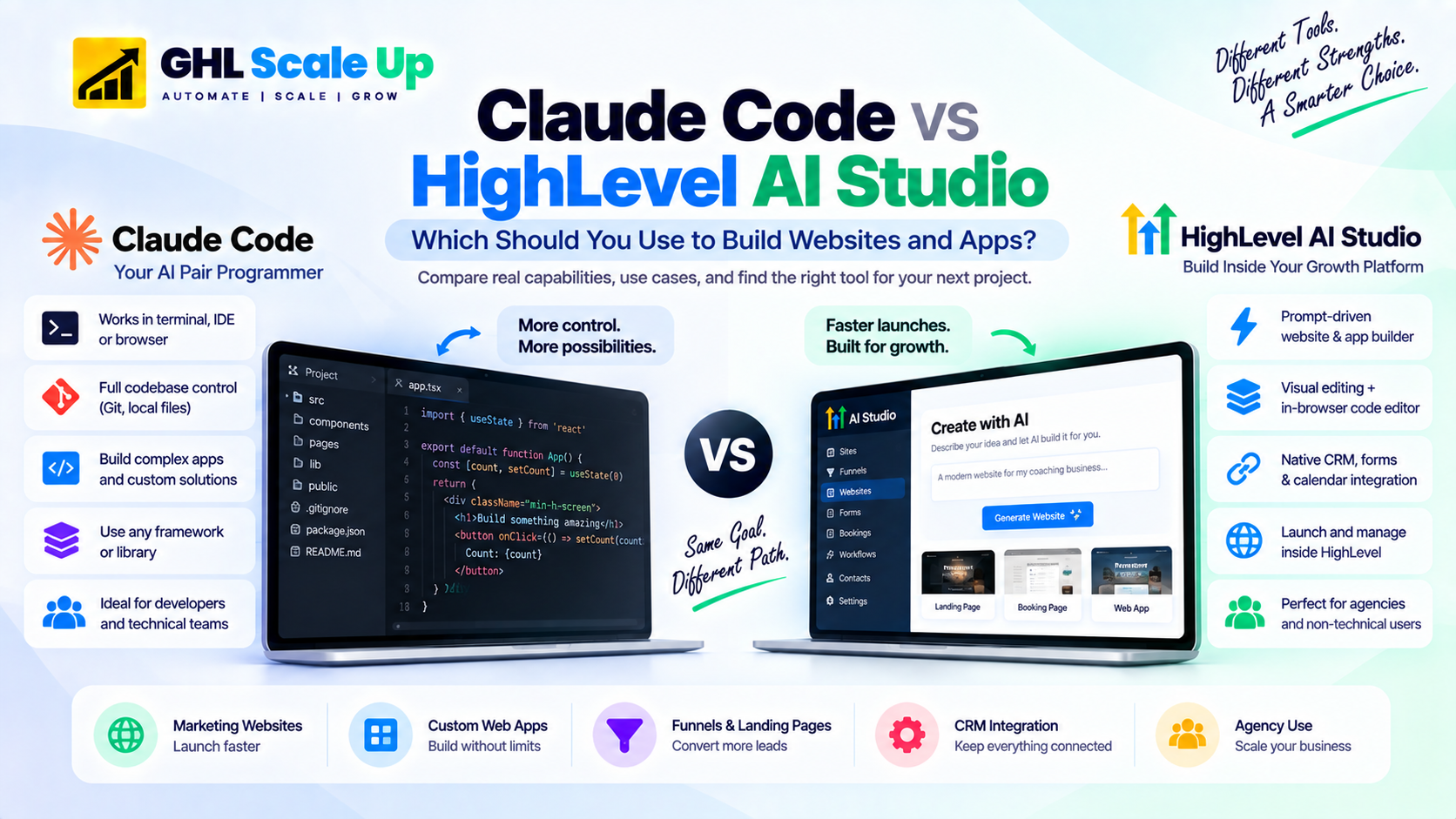
Claude Code is Anthropic's agentic coding tool it works in a terminal, IDE, desktop app, or browser, reading and editing a real codebase, running commands, and managing Git. It's built for software development generally, not for any one platform.
HighLevel AI Studio is a prompt-driven builder inside HighLevel that generates websites, landing pages, forms, and interactive web experiences from a description, a URL, or a reference image, with visual editing and an in-browser code editor layered on top.
The difference that matters isn't which one is more capable in the abstract. It's that Claude Code operates on a codebase you control, on infrastructure you choose, while AI Studio operates inside HighLevel's environment, generating and hosting the project within that ecosystem. Everything else in this comparison follows from that one distinction.
Is Claude Code Better Than HighLevel AI Studio for Building Websites?
For a genuinely custom website one with reusable components, specific architecture decisions, external APIs, or a testing and deployment pipeline yes. Claude Code gives you a real repository, Git history, the ability to run and debug code locally, and no platform boundary around what libraries or services you can use.
For a marketing website that needs to launch fast, connect to HighLevel's CRM, and be editable by a non-developer afterward, this advantage matters less than it sounds. Claude Code is generally the stronger choice when the website behaves like a software project rather than a marketing asset when it has logic, integrations, and structure that benefit from version control and a real development workflow, not just pages and copy.
Is HighLevel AI Studio Better for Building Websites and Funnels Inside GHL?
For anything that needs to be a HighLevel asset from day one a landing page tied to a funnel, a booking page that needs the CRM to see every submission, a client site that a non-technical team member will edit next month yes. AI Studio generates the site, and you connect supported forms and calendars to it directly, so a submission can trigger a HighLevel workflow without any external plumbing.
For GHL agencies specifically, this is the practical advantage that matters: the site isn't a separate system you have to integrate with the CRM afterward. It's already inside it.
Which Tool Gives You More Control Over the Code?
Neither tool has "no code access" anymore that would be an outdated claim about AI Studio specifically. AI Studio's Code Editor is a real, CodeMirror-powered editor that lets you view, search, and edit the TypeScript, JSX, CSS, and JSON files behind an AI-generated project, with version history and one-click rollback, directly in the browser.
Claude Code's control operates at a different layer entirely: a real filesystem, a terminal, Git branches and commits, the ability to install any package, run tests, and connect to external tools through MCP. The honest distinction is where the development environment lives, not whether code editing exists at all. AI Studio gives you control over the project's code, inside HighLevel's environment. Claude Code gives you control over the entire environment.
Which Is Better for Custom Web Apps and Complex Projects?
HighLevel describes AI Studio as capable of generating interactive web apps, dashboards, and multi-page experiences, not just static landing pages that capability is real and shouldn't be understated. What AI Studio doesn't give you is a conventional development environment around that code: no local repository, no test runner, no framework-level dependency management you control directly, no CI pipeline.
For a project with authentication, a database, third-party services, and custom business logic that needs to be tested and debugged like software, Claude Code is the more natural environment because that's what it's built for. The dividing line is project complexity and how much the app needs to behave like conventionally engineered software, not a hard cap on what AI Studio can visually produce.
Which Tool Is Better for HighLevel Funnels, Forms, Calendars, and CRM-Connected Pages?
This is AI Studio's clearest advantage. Forms and calendars built or connected inside AI Studio feed directly into HighLevel's CRM and can fire HighLevel workflows the moment someone submits or books no external form-relay, no webhook you have to build and maintain. A page generated in AI Studio, published on a custom domain, is already a HighLevel asset that shows up in the same pipelines and automations as everything else in the account.
Claude Code can absolutely build a form or a booking UI. It just doesn't know your HighLevel account exists unless you build that connection yourself through the HighLevel API, a webhook, or an MCP server someone has configured for that purpose. That's third-party integration work, not something Claude Code does natively, and it's worth being precise about that distinction rather than implying otherwise.
Which Is Easier for a Non-Developer or Agency Owner?
AI Studio: prompt-driven, visual editing, live preview, publish with a click, no separate hosting decision to make. An agency owner or a client can iterate on copy and layout without touching code.
Claude Code: a terminal or IDE-based workflow that assumes some comfort with a development environment, even though the actual coding is handled by Claude. The learning curve isn't about difficulty in the abstract it's that Claude Code hands you the same tools a developer uses (repositories, commands, deployment decisions), and someone has to own those decisions. That's a feature for a technical team and friction for someone who just wants a page published today.
Can You Take a HighLevel AI Studio Project and Continue Development in Claude Code?
Not officially, as of this writing. AI Studio's Code Editor is built to keep editing inside the browser HighLevel's own documentation frames not having to download files as a benefit, not a limitation. There's no "download codebase as ZIP" option in current official documentation. This is corroborated independently: GHL agencies have posted open feature requests asking HighLevel to add exactly this moving an AI Studio project into the standard Sites builder, or exporting it as usable files with one commenting that they built their own manual process to archive AI Studio sites "until GoHighLevel adds an official export feature." A paid third-party browser extension exists specifically to scrape AI Studio's project files out of the live code editor, because no first-party way to do it exists.
This is a different situation from the "AI Studio locks your code in forever" narrative some older articles pushed you can see and edit the code, and HighLevel could ship an export path at any time. But treat a native export as unverified until HighLevel's documentation confirms it, and don't build a client's long-term primary asset in AI Studio assuming it can later be handed to a developer to take elsewhere.
Can You Use Claude Code and HighLevel AI Studio Together?
Yes, but not as a clean "prototype in AI Studio, then export into Claude Code" pipeline that workflow doesn't officially exist yet. What does work in practice:
- Different layers, same project. Use AI Studio for the HighLevel-native pieces landing pages, forms, booking flows connected to the CRM while Claude Code builds anything that needs to live outside HighLevel, like a custom app, an API, or a client portal with its own infrastructure. The two pieces integrate through HighLevel's API and webhooks, not through a shared codebase.
- Rebuild, don't migrate. If an AI Studio prototype proves out the design and content, a developer can use it as a visual reference and rebuild the relevant pages as a real codebase in Claude Code a manual step, not an export.
Where this creates unnecessary complexity: running two build environments for a project simple enough that one tool could have handled end to end. The point of using both is covering two genuinely different needs, not defaulting to both out of habit.
Which Tool Is Better for Large Website Migrations?
For a migration involving 100+ pages, bulk redirects, repeated templates, and structured data that needs programmatic transformation, Claude Code has a real advantage it can operate against a codebase, script bulk changes, and run against real files rather than regenerating each page through a prompt. Community discussion around large migrations into AI Studio-style builders consistently raises the same friction points: prompt-driven regeneration doesn't scale cleanly to hundreds of near-identical pages the way a script iterating over a template does.
That doesn't make AI Studio irrelevant to a migration if the destination is a HighLevel-hosted site, AI Studio (or HighLevel's native site builder) is still where the final experience needs to live and connect to the CRM. The realistic pattern is Claude Code handling the bulk content transformation and structure, with the final HighLevel-facing pages assembled or connected inside HighLevel.
How Much Does Claude Code Cost Compared With HighLevel AI Studio?
Neither tool has a single number that means anything on its own usage and development time affect the real cost more than the sticker price.
Claude Code rides on a Claude subscription: no Claude Code on the Free plan, Pro at $20/month (or $17/month billed annually), Max at $100/month (5x Pro's usage) or $200/month (20x), and Team plans where Claude Code specifically requires Premium seats (around $100–125/seat, 5-seat minimum) rather than the cheaper Standard tier. Enterprise is custom-priced. There's also pay-per-token API access with no subscription. Verify current figures at claude.com/pricing, since Anthropic has adjusted these plans and included usage more than once in 2026.
AI Studio doesn't have its own separate subscription it's a Labs feature bundled into a HighLevel plan ($97 Starter, $297 Unlimited, or $497 Agency Pro), and its usage draws from whichever AI Employee tier the location is on: Pay-Per-Use (token billing, no monthly fee), Growth ($50/month/location), or Unlimited ($97/month/location, which includes a larger AI Studio allowance). AI Studio ran free during HighLevel's Summer of AI promotion, which ended August 31, 2026 so usage should now be billing under one of these tiers rather than free.
The comparison that actually matters: a cheaper tool that takes a developer three extra hours to configure correctly isn't cheaper. Weigh subscription cost against the development and maintenance time each path actually requires for the specific project.
Which Tool Is Better for Maintaining a Website After Launch?
This is the question a lot of comparisons skip, and given AI Studio's export limitation above, it deserves real weight here. Ask who fixes a bug, adds a feature, or redesigns a section six months from now and can they do it in whichever tool built the original.
A site built in AI Studio stays fully editable inside AI Studio, with version history and rollback, as long as the account stays on HighLevel. A site built with Claude Code lives in a repository anyone with access and the right skills can pick up, hosted wherever you chose to put it, independent of any single platform's continued existence in your stack.
The practical rule: if there's a real chance the client leaves HighLevel, or a different developer needs to take over later without HighLevel access, don't make AI Studio the only copy of that asset.
Which Tool Should a GoHighLevel Agency Choose?
Choose AI Studio when:
the project lives primarily inside HighLevel, the client needs native forms or calendars connected to the CRM, speed and non-technical iteration matter more than architecture, and there's no realistic scenario where the project needs to leave HighLevel.
Choose Claude Code when:
the project is code-heavy, needs custom APIs or infrastructure, will be maintained by a developer using Git, or needs to be hosted independently of any single platform.
Use both when:
an agency needs HighLevel-native CRM-connected pages for one part of a client's presence and a genuinely custom application for another built and hosted separately, connected through HighLevel's API rather than a shared codebase.
Claude Code vs HighLevel AI Studio: Which One Should You Choose?
| Requirement | Better Choice | Why |
|---|---|---|
| HighLevel landing page | AI Studio | Native publishing, no separate hosting decision |
| HighLevel funnel or form | AI Studio | Connects directly to CRM and workflows |
| CRM-connected booking experience | AI Studio | Calendar and CRM live in the same environment |
| Simple client website inside GHL | AI Studio | Fastest path to a non-technical, editable site |
| Highly custom website or app | Claude Code | Real development environment and architecture control |
| Large codebase or bulk migration | Claude Code | Scriptable, repository-based workflow |
| Custom API integration | Claude Code | No platform boundary on external services |
| Git-based development | Claude Code | Native version control and collaboration |
| Project that must survive leaving HighLevel | Claude Code | No official AI Studio export exists yet |
| Hybrid project (CRM pages + custom app) | Both | Different layers, integrated via API not a shared codebase |
Final Verdict
Choose HighLevel AI Studio when the project is fundamentally a HighLevel asset its value comes from living inside the CRM, connecting to forms and calendars, and being editable by a non-developer. Choose Claude Code when the project is fundamentally a software project its value comes from architecture, external integrations, and a development team that needs Git and a real environment. Use both when a client genuinely needs HighLevel's native business infrastructure for part of their presence and custom software for another part, built and hosted separately.
The one adjustment to make from how this comparison usually gets framed: don't treat AI Studio as a rapid prototype you'll "export into Claude Code later." As of now, that path doesn't officially exist. If long-term portability matters for a specific project, that's a reason to start it in Claude Code, not a problem to solve after the fact.
Frequently Asked Questions
Is Claude Code better than HighLevel AI Studio?
Neither is universally better. Claude Code is stronger for custom, code-heavy projects with external infrastructure; AI Studio is stronger for HighLevel-native sites and funnels that need CRM connectivity and fast, visual iteration.
Is HighLevel AI Studio good enough for professional websites?
Yes, for HighLevel-hosted marketing sites, landing pages, and funnels HighLevel's own documentation describes it generating full multi-page websites and interactive experiences, not just single landing pages.
Can Claude Code build websites?
Yes it can build a website's full codebase, from static pages to applications with a backend, but you're responsible for choosing and managing where it's hosted.
Can HighLevel AI Studio build web apps?
Yes, per HighLevel's own documentation, which describes AI Studio generating interactive front-end experiences and dashboards, not only landing pages. It runs inside HighLevel's environment rather than as an independent, freely hostable application.
Can I export HighLevel AI Studio code?
Not through an official, documented feature as of this writing. The Code Editor supports full in-browser editing, but there's no native "download the full project" function, and HighLevel users have publicly requested that this be added.
Can I edit AI Studio code with Claude Code?
Not directly, since there's no official export path connecting the two. A developer can use an AI Studio project as a visual and content reference and rebuild the relevant parts in a real codebase with Claude Code.
Which is better for GoHighLevel agencies?
It depends on the project, not the agency generally AI Studio for CRM-connected client sites and funnels, Claude Code for custom applications or anything that needs to be portable outside HighLevel.
Which is better for large websites?
Claude Code, for genuinely large or content-heavy migrations that benefit from scripted, repository-based bulk changes rather than page-by-page prompt generation.
Which is better for custom web development?
Claude Code it provides a full development environment (Git, testing, external packages, infrastructure choice) that AI Studio's in-platform editor doesn't attempt to replace.
Is HighLevel AI Studio cheaper than Claude Code?
They're not directly comparable AI Studio has no standalone price and bills through your HighLevel plan and AI Employee tier, while Claude Code requires a Claude subscription starting at $20/month. Compare the total cost for your specific project, not the two price tags in isolation.
Related Articles in This Series
Need Help Choosing Your Build Tool?
We help agencies choose the right tool for each project AI Studio for CRM-connected pages, Claude Code for custom apps.
Book Your Free Project Assessment
GHL Scale Up is a specialised GoHighLevel implementation and SaaS growth agency. Based in India, we serve agencies and businesses across 6 countries with 200+ GoHighLevel builds delivered. This guide reflects direct experience building websites and apps with both Claude Code and HighLevel AI Studio. All tool capabilities verified against official documentation as of September 2026.
ghlscaleup.com