
How GoHighLevel Fits Into an Ecommerce CRM and Automation Stack
The architecture is straightforward once it's explicit: your ecommerce platform (Shopify or WooCommerce) remains the system of record for products, orders, inventory, and payments. GoHighLevel sits downstream of it as the customer relationship and automation layer receiving customer and order events, organizing them into contact records, and triggering communication and sales workflows based on what happens.
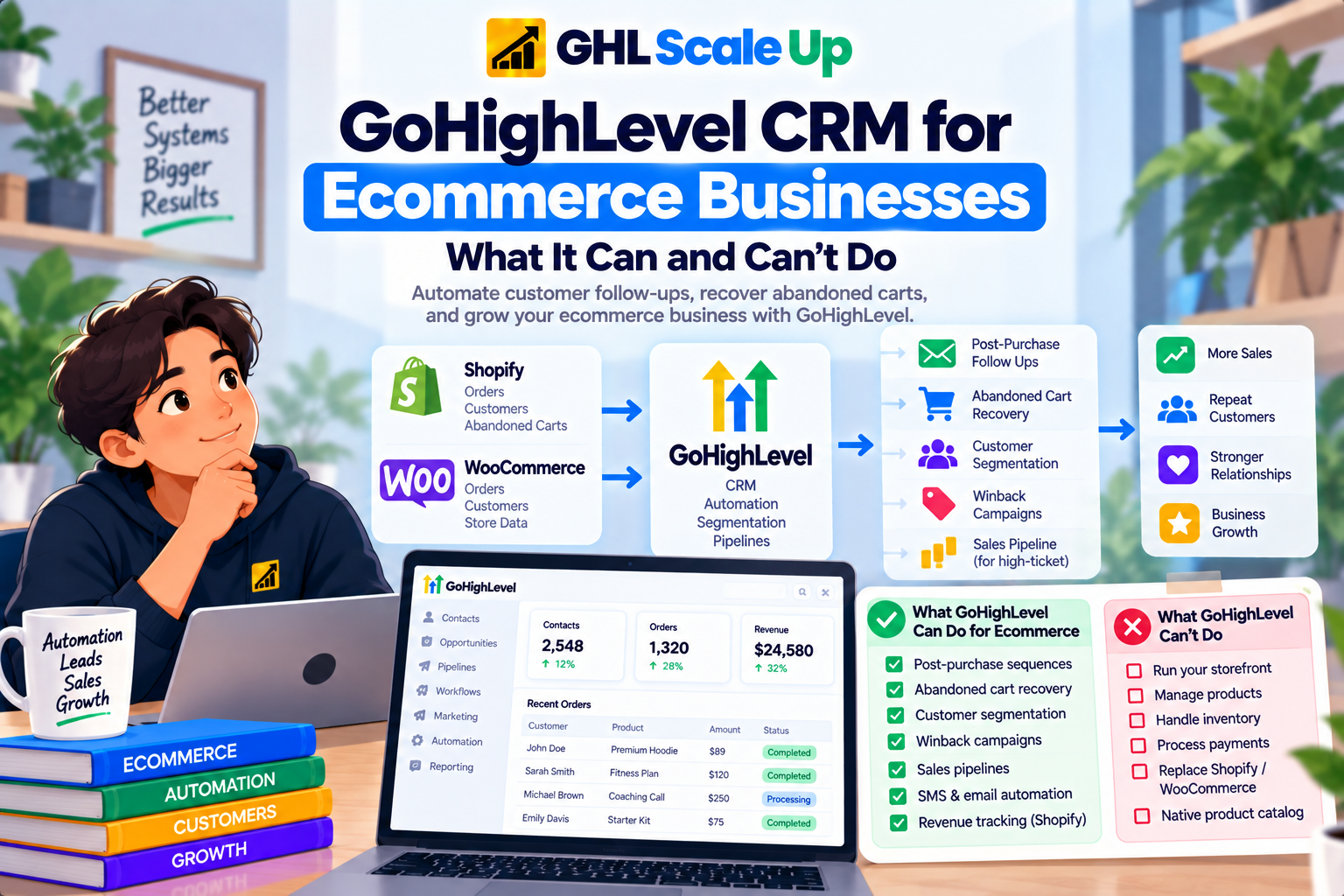
The flow looks like: ecommerce platform event (new customer, new order, checkout started) → integration → GoHighLevel contact record → segmentation/tagging → workflow → email/SMS/pipeline action → customer outcome. Nothing about a purchase, a product, or inventory lives natively inside GoHighLevel in this model it lives in Shopify or WooCommerce, and GoHighLevel works with a copy of the relevant data once it arrives.
Is GoHighLevel Actually an Ecommerce CRM, or a General CRM Ecommerce Businesses Use?
This distinction matters more than it sounds. A CRM built specifically for ecommerce typically ships with product-level purchase history, native abandoned-cart tracking, and purpose-built ecommerce segmentation out of the box. GoHighLevel is a general-purpose CRM and automation platform contacts, opportunities, pipelines, tags, custom fields, workflows that becomes ecommerce-relevant once connected to a store.
That's not a disqualifier, but it changes what "using GoHighLevel for ecommerce" actually means in practice: you're not getting a purpose-built ecommerce CRM's default reporting and segmentation, you're building ecommerce-specific automation on top of general CRM primitives, using whatever order and customer data your integration passes through.
GoHighLevel's Native Shopify Integration vs. Its Non-Native WooCommerce Connection
This is the single clearest technical distinction in the whole evaluation, and it's worth getting right before anything else.
Shopify has a native, officially supported GoHighLevel integration. It connects via a Shopify custom app and Admin API access token at the sub-account level, and HighLevel's own documentation confirms it handles customer sync (new and updated customers into Contacts), order sync (order details, values, products), revenue tracking for reporting, optional mapping of orders to pipelines/opportunities with configurable handling for paid, pending, and refunded orders, abandoned checkout recovery, and Shopify variables usable inside emails and SMS once a Shopify-based workflow fires.
WooCommerce has no equivalent native integration. Every credible source on this including GoHighLevel's own integration ecosystem writers agrees it has to be connected through Zapier, Make, GoHighLevel's inbound webhook trigger paired with WooCommerce's native outbound webhooks, or a third-party WordPress plugin. Webhook-based setups are lower latency than polling-based Zapier automations but require more manual field mapping; plugin-based options are convenient but need to be checked for active maintenance, since they can break when either platform updates.
If your store runs on Shopify, this is a meaningfully more direct setup than if it runs on WooCommerce that's worth knowing before you scope the build.
What GoHighLevel Can Actually Automate Once Ecommerce Data Is Connected
Once customer and order data is flowing in natively from Shopify, or via integration from WooCommerce the automation itself runs on GoHighLevel's standard workflow engine, using the same triggers, filters, and actions that power every other kind of automation on the platform. In practice, that means:
- Post-purchase sequences order confirmation follow-up, delivery-timed review requests, product education, triggered off the order-sync event.
- Abandoned checkout recovery natively supported for Shopify; for WooCommerce, dependent on whatever webhook or plugin path was set up to pass the checkout-started event through.
- Customer lifecycle segmentation tagging and custom fields built from purchase count, product category, or order value, used to branch workflows differently for first-time versus repeat customers.
- Winback/reactivation workflows triggered by the absence of a new order event within a defined window.
- Sales pipeline visibility orders optionally mapped into opportunities and pipeline stages, giving a team a CRM-style view of ecommerce revenue alongside whatever pre-sale nurture is happening.
None of this replaces Shopify's or WooCommerce's own order and inventory management it's what happens to the customer relationship once an order event exists.
Where a CRM Layer Matters More: High-Ticket and Sales-Assisted Ecommerce
Not every ecommerce business needs a CRM in the traditional sense, and this is where GoHighLevel's fit genuinely diverges by business model. A low-touch, low-price storefront product page → cart → checkout → order mostly needs marketing automation and transactional messaging, which is exactly the territory where dedicated ecommerce tools tend to be stronger out of the box.
A store where purchases involve consultation, qualification, custom quoting, or a sales call before the sale closes high-ticket physical products, made-to-order goods, B2B ecommerce, wholesale looks structurally more like: lead → qualification → sales process → purchase → post-purchase, rather than a pure transactional funnel. That's the model a CRM's pipeline, opportunity stages, and lead-nurture workflows are actually built for, and it's where GoHighLevel's general CRM strength becomes a genuine advantage over a purely ecommerce-native marketing tool that has no concept of a sales pipeline at all.
Where GoHighLevel May Not Replace a Dedicated Ecommerce Marketing Platform
Being direct about this matters more than covering it briefly. For a high-volume, low-touch Shopify or WooCommerce store, GoHighLevel's own ecosystem including GHL Scale Up's own published comparison content is upfront that dedicated ecommerce marketing platforms like Klaviyo or ActiveCampaign currently offer stronger native abandoned-cart handling, deeper product-based segmentation, and more mature purchase-behavior triggers built specifically for ecommerce data. GoHighLevel's own store builder is explicitly positioned, in GHL Scale Up's own published guidance, as suited to a small catalog or a service business selling a handful of add-on products not as a competitor to Shopify for large catalogs, complex variants, or high order volume.
Where this actually shows up in practice: sophisticated product-level segmentation (browse behavior, specific SKU affinity), advanced merchandising or recommendation logic, and deep ecommerce-specific analytics are areas where a purpose-built ecommerce marketing stack is still likely to outperform a general CRM adapted to the job.
GoHighLevel vs. Klaviyo for Ecommerce Customer Automation
| Capability | GoHighLevel | Klaviyo (ecommerce-native) |
|---|---|---|
| Core design | General CRM + workflow automation | Purpose-built ecommerce marketing platform |
| Shopify data | Native integration (customers, orders, revenue) | Native, ecommerce-specific data model |
| Abandoned cart | Native for Shopify; integration-dependent for WooCommerce | Native, purpose-built |
| Sales pipeline / opportunities | Native CRM feature | Not a core capability |
| SMS + email in one platform | Yes, native | Yes, native |
| Lead nurture before purchase | Native (forms, workflows, pipelines) | Limited outside of email flows |
| Product-level segmentation depth | Basic, built from synced order/tag data | Deep, ecommerce-native |
Neither platform is universally better the table above is descriptive, not a scorecard. A business needing a CRM and sales pipeline alongside ecommerce automation has a reason to lean toward GoHighLevel; a business needing deep, ecommerce-native segmentation and merchandising-level automation has a reason to lean toward a dedicated tool like Klaviyo.
Native vs. Integration-Dependent Ecommerce Capabilities: A Quick Reference
| Ecommerce Use Case | Native to GoHighLevel? | What It Actually Requires |
|---|---|---|
| Shopify customer/order sync | Yes | Shopify custom app + Admin API token |
| Shopify abandoned checkout recovery | Yes | Same native Shopify integration |
| WooCommerce customer/order sync | No | Zapier, Make, webhook, or third-party plugin |
| WooCommerce abandoned checkout | No | Depends entirely on the integration path chosen |
| Order-to-pipeline mapping | Yes (Shopify) | Configured during Shopify integration setup |
| Product catalog / inventory | No | Stays in Shopify/WooCommerce; not a GoHighLevel function |
| Post-purchase email/SMS workflows | Yes | Standard GoHighLevel workflow engine, once order data exists |
Practical Implementation Risks Worth Planning For
Ecommerce automation is only as reliable as the data feeding it, and a few failure points come up repeatedly regardless of which platform you're connecting:
- Duplicate contacts from a customer checking out as a guest multiple times with slightly different details.
- Missing or delayed order data on WooCommerce setups running through polling-based Zapier plans rather than real-time webhooks.
- Incorrect order-to-pipeline mapping, especially around refunded or partially fulfilled orders, if that mapping wasn't deliberately configured.
- Two systems both acting as "source of truth" for the same customer field, creating silent conflicts decide upfront which platform owns which data.
None of these are reasons to avoid the integration; they're reasons to test it deliberately before relying on it for live customer communication.
A Decision Framework for Evaluating GoHighLevel for Your Ecommerce Business
Consider GoHighLevel if your ecommerce business needs:
- A CRM and sales pipeline alongside marketing automation
- Lead nurture or qualification before a purchase happens
- SMS and email in one platform rather than several separate tools
- High-ticket, custom, or sales-assisted ecommerce workflows
- A single platform already used for other parts of the business (booking, forms, funnels)
A dedicated ecommerce platform or marketing tool may be more appropriate if you primarily need:
- Deep, ecommerce-native product segmentation and merchandising automation
- Large catalog management with complex variants
- The most mature, purpose-built abandoned-cart and browse-behavior automation available
- High order volume with minimal sales-assisted touchpoints
Many ecommerce businesses land in between using Shopify or WooCommerce as the platform of record, GoHighLevel for CRM and follow-up, and accepting that certain deep ecommerce-marketing capabilities may still be better served elsewhere. If you're weighing that build against your current tool stack, GHL Scale Up's integrations work covers how Shopify, WooCommerce, and other systems connect into a GoHighLevel setup.
The Actual Fit Question
GoHighLevel isn't an ecommerce platform, and it isn't a purpose-built ecommerce marketing tool either it's a general CRM and automation layer that becomes genuinely useful for ecommerce once connected to Shopify (natively) or WooCommerce (via integration). The businesses that get the most out of it are the ones where a sales pipeline, lead nurture, or unified CRM actually matters high-ticket, custom, or sales-assisted stores especially. For high-volume, low-touch transactional stores that mainly need deep ecommerce-native segmentation and merchandising automation, a dedicated tool may still do more of that work natively. The right answer depends on which of those two shapes your business actually is.
Frequently Asked Questions About GoHighLevel for Ecommerce
Can GoHighLevel be used for ecommerce?
Yes, as a CRM and automation layer connected to an ecommerce platform it doesn't run the storefront, catalog, or checkout itself.
Is GoHighLevel an ecommerce CRM?
It's a general-purpose CRM that becomes ecommerce-relevant once connected to Shopify or WooCommerce; it isn't purpose-built for ecommerce the way a dedicated ecommerce marketing platform is.
Does GoHighLevel integrate with Shopify?
Yes, natively through a Shopify custom app and Admin API token, supporting customer sync, order sync, revenue tracking, abandoned checkout recovery, and optional pipeline mapping.
Does GoHighLevel integrate with WooCommerce?
Not natively. WooCommerce connects through Zapier, Make, GoHighLevel's webhook trigger paired with WooCommerce's native webhooks, or a third-party WordPress plugin.
Can GoHighLevel replace Shopify?
No. GoHighLevel has its own small-scale store feature, but it isn't built to compete with Shopify for large catalogs, complex variants, or high order volume.
Can GoHighLevel replace Klaviyo?
Not entirely for ecommerce-native marketing depth GoHighLevel offers native CRM and pipeline capability Klaviyo doesn't, while Klaviyo currently offers stronger native ecommerce segmentation and abandoned-cart automation.
What are GoHighLevel's limitations for ecommerce?
Weaker native ecommerce segmentation and merchandising automation than dedicated ecommerce marketing tools, no native WooCommerce integration, and a store feature not intended for large catalogs.
Related Articles in This Series
Need Help Evaluating GoHighLevel for Ecommerce?
We help ecommerce businesses decide if GoHighLevel fits their stack and set up the right integrations.
Book Your Free Assessment
GHL Scale Up is a specialised GoHighLevel implementation and SaaS growth agency. Based in India, we serve agencies and businesses across 6 countries with 200+ GoHighLevel builds delivered. This guide reflects direct experience helping ecommerce businesses evaluate and set up GoHighLevel for CRM and automation. All integration details verified against official documentation as of September 2026.
ghlscaleup.com