

What Each Platform Is Actually Built For
GoHighLevel's architecture is agency-first by design. Sub-accounts, Snapshots, and SaaS Mode exist specifically to let one agency manage many separate client environments from a single dashboard, with unlimited contacts and users on every plan.
HubSpot was designed for a single company's internal team. Its Hub structure (Marketing, Sales, Service, Operations) maps to internal departments sharing one contact database it isn't built with multi-client agency delivery in mind.
The practical test: are you building marketing systems for other businesses, or running marketing for your own? If you manage multiple clients, that structural difference matters more than any individual feature.
GoHighLevel vs HubSpot: Pricing Comparison (Verified 2026 Figures)
Pricing is where most comparisons stop at headline numbers. These figures were independently checked against current official and third-party sources rather than carried over from an earlier version of this page.
| GoHighLevel | HubSpot | |
|---|---|---|
| Entry plan | $97/mo (Starter, 3 sub-accounts) | Free CRM (limited features, no automation) |
| Mid-tier plan | $297/mo (Unlimited, unlimited clients) | $890/mo (Marketing Hub Pro, 3 seats, 2,000 contacts) |
| Advanced plan | $497/mo (Agency Pro, SaaS Mode) | $3,600/mo (Marketing Hub Enterprise, 5 seats, 10,000 contacts) |
| Contacts | Unlimited on all plans | Scales with cost roughly $225–$250/mo per extra 5,000 on Pro |
| Users/seats | Unlimited on all plans | $45–$75/mo per additional seat beyond base |
| Onboarding fee | None | $3,000 (Pro) or $7,000 (Enterprise), mandatory |
| White-labeling | Yes (Unlimited and Agency Pro) | Not available at any tier |
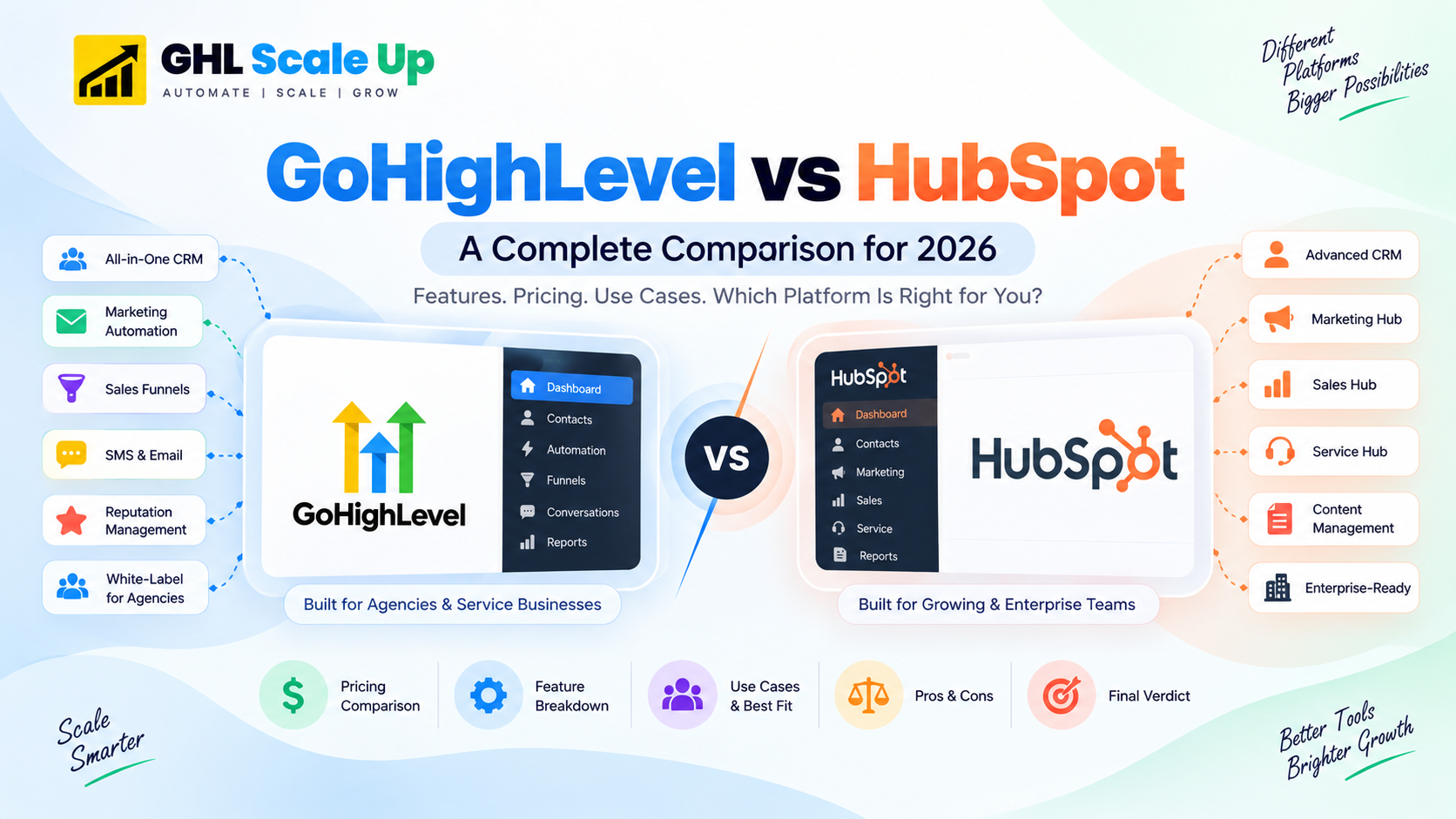
The 10-client agency scenario: GoHighLevel Unlimited covers all 10 clients in separate sub-accounts for a flat $297/month. HubSpot has no sub-account equivalent, so 10 clients require 10 separate Marketing Hub Professional accounts at $890/month each roughly $8,900/month. Neither number is the full story: GoHighLevel adds usage-based fees for SMS, email, and AI features (typically $20–$150/month depending on volume), and HubSpot's contact-scaling costs compound as any client list grows. Factor both in before comparing headline prices directly.
For the complete GoHighLevel pricing breakdown including every usage fee, see the full GoHighLevel pricing guide.
Breadth vs. Depth: Why Feature-Counting Misleads
Most comparisons treat "more features" as "better platform." That's the wrong lens here. GoHighLevel is built for breadth CRM, funnels, SMS, booking, reputation management, and course hosting all live in one flat-rate platform, each covering the core of what a service business or agency client needs. HubSpot is built for depth in a narrower set of functions its CRM, attribution modeling, and lead scoring go further than GoHighLevel's equivalents, at a correspondingly higher cost and narrower scope.
Neither approach is objectively better. An agency running 10 straightforward client accounts benefits more from GoHighLevel's breadth at a flat cost than from any single feature's extra depth. A B2B company running one complex, long-cycle sales process benefits more from HubSpot's depth in that one area than from GoHighLevel's wider but shallower toolset. This distinction is the actual basis for the rest of this comparison.
Feature Comparison: Where Each Platform Wins
| Feature | GoHighLevel | HubSpot | Winner |
|---|---|---|---|
| CRM & pipelines | Full CRM, unlimited pipelines, tags, smart lists | Predictive lead scoring, deeper contact timeline, progressive profiling | HubSpot (depth) / GHL (cost) |
| Marketing automation | Visual builder, 30+ triggers, 100+ actions, AI steps | Multi-touch attribution, smart content, behavioral scoring | HubSpot (enterprise reporting) / GHL (value) |
| SMS marketing | Native, usage-based pricing | No native SMS requires third-party integration | GoHighLevel |
| Funnel/landing pages | Unlimited, native, no extra cost | Available on Pro+; no dedicated funnel builder | GoHighLevel |
| White-label / resale | Full white-label + SaaS Mode on Agency Pro | Not available at any tier | GoHighLevel |
| Multi-client management | Native sub-account architecture | No equivalent separate accounts per client | GoHighLevel |
| Third-party integrations | 200+ native + Zapier/API | 1,500+ native, deeper ecosystem | HubSpot |
| Reporting & analytics | Functional for agency needs | Multi-touch attribution, revenue reporting (Enterprise) | HubSpot |
| Course/membership hosting | Built in on all plans | Not available natively | GoHighLevel |
Agency Use Case: Where GoHighLevel's Architecture Fits
If you build, configure, or manage marketing systems for other businesses, GoHighLevel's structural decisions solve problems HubSpot wasn't designed to address.
Sub-accounts
each client gets an isolated environment their own CRM, funnels, contacts, automations, and phone numbers managed from one agency dashboard. HubSpot has no equivalent; each client requires a fully separate account.
Snapshots
a reusable template of a complete client setup, deployable to a new account in minutes rather than hours. For an agency onboarding several clients a month, this compounds quickly.
SaaS resale
only GoHighLevel allows white-labeling the entire platform and reselling it as a branded product HubSpot offers no white-label option at any tier.
For a fuller look at how agencies structure this, see GoHighLevel for agencies.
When HubSpot Is the Right Choice
An honest comparison acknowledges where the alternative wins outright. HubSpot is the better choice in several well-defined scenarios, not just as a fallback:
Enterprise B2B companies with complex sales cycles.
HubSpot's contact timeline, predictive lead scoring, and multi-touch attribution are built for tracking a prospect across months of touchpoints before a deal closes a use case GoHighLevel's flatter CRM model doesn't address as deeply.
Large in-house teams needing governance.
Enterprise permissions, audit logs, and role-based access are built for organizations with dozens of internal users who each need different, controlled levels of access not a single agency operator managing external client accounts.
Businesses needing deep third-party integrations.
At 1,500+ native integrations against GoHighLevel's 200+, HubSpot's ecosystem is genuinely broader this matters most for companies with an existing stack of specialized tools that need to stay connected.
Product-led growth companies.
HubSpot's behavioral tracking, custom objects, and event-based scoring suit product-qualified-lead models more directly than GoHighLevel's agency-oriented toolset was designed for.
The Verdict: Which Platform Should You Choose?
| Your Situation | Recommended Platform | Why |
|---|---|---|
| Marketing agency with 3+ client accounts | GoHighLevel Unlimited ($297/mo) | Sub-account architecture, unlimited clients at flat cost |
| Agency wanting to resell a branded SaaS product | GoHighLevel Agency Pro ($497/mo) | SaaS Mode + white-label; HubSpot has no equivalent |
| Service business (real estate, dental, home services) | GoHighLevel Starter ($97/mo) | Native SMS and AI Voice Agent; HubSpot has no native SMS |
| Growing B2B business with dedicated marketing team | HubSpot Marketing Hub Pro ($890/mo) | Multi-touch attribution and behavioral scoring for complex pipelines |
| Enterprise company with a large marketing org | HubSpot Enterprise ($3,600/mo) | Governance, compliance, and multi-hub integration at scale |
| Currently on HubSpot with 3+ agency clients | Consider migrating to GoHighLevel | Cost savings and sub-account architecture |
| Currently on HubSpot with complex B2B sales cycles | Stay on HubSpot | Attribution depth and pipeline reporting justify the cost here |
What If You're Already on HubSpot?
If the comparison above points you toward switching, the practical next question is execution, not decision-making and that's a different guide's job. Migrating from HubSpot to GoHighLevel involves exporting your contact and deal data, rebuilding pipelines and automations in GHL, and running both platforms in parallel before cutover. For the full technical walkthrough, realistic timelines by account size, and the mistakes to avoid, see How to Migrate from HubSpot to GoHighLevel.
Frequently Asked Questions
Is GoHighLevel better than HubSpot?
GoHighLevel is better for marketing agencies managing multiple client accounts and service businesses needing native SMS and white-label capability. HubSpot is better for enterprise B2B companies with complex sales cycles and businesses needing deep third-party integrations. The answer depends on your business model, not on either platform being objectively superior.
How much does GoHighLevel cost compared to HubSpot?
GoHighLevel runs $97, $297, or $497/month flat, with unlimited contacts and users on every tier. HubSpot starts free but scales quickly Marketing Hub Professional is $890/month for 2,000 contacts and 3 seats, plus a mandatory $3,000 onboarding fee. For a 10-client agency, GoHighLevel costs $297/month total versus roughly $8,900/month on HubSpot.
Can GoHighLevel replace HubSpot?
For most agencies and service businesses, yes GoHighLevel covers CRM, pipelines, email, SMS, automation, booking, and funnels in one platform. The scenarios where HubSpot can't be replaced by GoHighLevel: enterprises needing deep third-party integrations, complex B2B lifecycle reporting, or predictive AI at the Enterprise tier.
Does HubSpot have a white-label option?
No, at any pricing tier. GoHighLevel offers white-label branding on the Unlimited plan and full SaaS Mode with a white-label mobile app on Agency Pro.
What does HubSpot do better than GoHighLevel?
Third-party integrations (1,500+ vs. 200+), enterprise reporting and multi-touch attribution, predictive lead scoring, contact timeline depth, and enterprise-grade permissions and governance. For large organizations with dedicated marketing and sales teams, this depth often justifies the higher cost.
Can I migrate from HubSpot to GoHighLevel?
Yes. The process involves exporting contact and deal data, rebuilding pipelines and automations, and running both platforms in parallel before cutover. Timelines vary by account complexity see the full migration guide for a realistic breakdown by account size rather than a single number.
Related Articles in This Series
Still deciding which platform is right for you?
We'll review your business model, contact volume, and revenue channels and tell you honestly which platform fits no sales pitch, just data.
Book Your Free Platform Strategy Call