
GoHighLevel vs Dubsado: The Short Answer
| If your main problem is... | Lean towards | Why |
|---|---|---|
| Turning an inquiry into a signed, paid, onboarded client with less admin | Dubsado | Its model is the client project: proposal, contract, invoice, scheduler and portal in one flow |
| Getting more leads and following up with them quickly by email and SMS | GoHighLevel | Multi-channel communication, funnels, forms and pipelines are central to it |
| Managing a sales pipeline with several stages and a team | GoHighLevel | Pipelines and opportunities are core. Dubsado states it is not a sales CRM |
| Running campaigns or bulk email | GoHighLevel | Dubsado states it is not a mass email platform |
| Running many client accounts as an agency | GoHighLevel | Sub-accounts, SaaS mode and API access on higher plans |
| A repeatable client flow for a solo or small team, without a marketing stack | Dubsado | A narrower tool can be easier to keep consistent |
| Both lead generation and a polished client flow | Depends | One platform configured well, or two with a defined hand-off. See the section on using both |
How the Two Platforms Are Built Differently
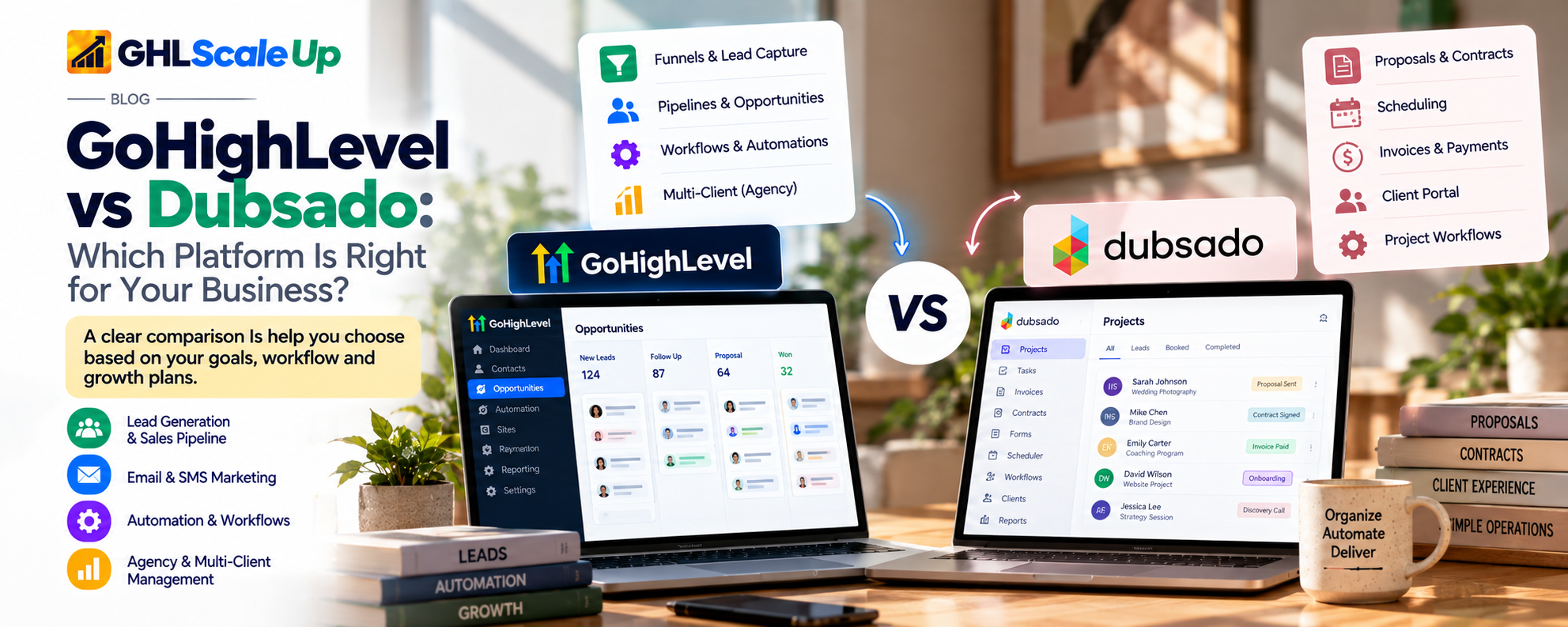
The useful difference is not the feature list. It is what each platform treats as its main record, because that shapes how everything else is set up.
GoHighLevel is organized around the contact. People enter through forms, funnels, calendars or imports, and move through pipelines as opportunities. Workflows act on contacts when something happens. It is sold as an agency platform: plans differ by the number of sub-accounts (client accounts), and higher plans add SaaS mode and API access. Because it is a broad platform, a business typically configures the parts it needs and ignores the rest.
Dubsado is organized around the project. A project holds messages, invoices, forms, tasks, events and notes for one client engagement, and Flows (its automation feature) apply a sequence of steps to a project. Dubsado describes itself as a client management platform for small service businesses, and is explicit about what it is not: "not a sales CRM", not an internal project management platform, and not a mass email platform. Dubsado's own help center goes into the project model in detail.
Practical difference: in GoHighLevel you design the journey out of general building blocks. In Dubsado the journey (lead, proposal, contract, payment, scheduling, onboarding) is already the shape of the tool, and you fill it with your own services and wording.
Where They Overlap, and Why Overlap Is Not Equivalence
Both platforms list forms, contracts, invoices, scheduling and automation. Matching labels do not mean matching depth, so the table describes what each documents and whether the two are directly comparable.
| Need | GoHighLevel | Dubsado | Comparable? |
|---|---|---|---|
| Lead capture | Forms, funnels and websites; contacts enter pipelines and workflows | Lead capture forms that start a project; 1 active form on Starter, unlimited on Premier | Partly. GoHighLevel is stronger on acquisition; Dubsado on routing into a client project |
| Contact and client records | Contacts with opportunities, tags and custom fields | Clients and projects with statuses, tags and a portal | Different models |
| Sales pipeline | Pipelines with stages; opportunities tied to contacts | Project statuses; Dubsado says it is not a sales CRM | GoHighLevel is the stronger fit for pipeline work |
| Proposals and packages | Documents & Contracts: proposals and estimates with text blocks and pricing tables | Proposals and packages clients select; public proposals on Premier only | Both exist. Experience for the client differs; test with your own offer |
| Contracts and e-signature | E-signature with a certificate recording signer details, IP address and timestamp; no conditional logic in documents | Contract templates with e-signature, one contract per project | Comparable. Check your own contract rules |
| Invoices and payments | Invoices generated from signed documents; one-time or recurring; payment gateways you connect | Invoices, payment plans and reminders; Dubsado Payments (Stripe), PayPal, Square | Comparable for common cases. Verify your processor and region |
| Scheduling | Calendars, including round robin and group calendars | Scheduler on Premier only, linked to calendars | GoHighLevel is broader; Dubsado simpler |
| Automation | Workflows with triggers, conditions and many action types; some actions carry usage costs | Flows on Premier: 15 documented actions (email, forms, contracts, scheduler, invoices, tasks, status, tags, portal, flow control) | Not directly comparable. Dubsado conditional branching not confirmed from documentation reviewed |
| Email and SMS | Email and SMS marketing and conversations, with usage-based charges | Email within client workflows; SMS not mentioned in the documentation reviewed | GoHighLevel is stronger for outbound messaging |
| Client portal | A branded client portal app is listed as a paid add-on; scope not compared here | Branded portals on all plans, with optional custom domain | Needs checking against your needs |
| Reporting | Agency and user reporting on higher plans; scope not compared | Project status, dashboards and basic income tracking | Needs verification |
| Integrations | Webhooks and API (Basic on Unlimited, Advanced on Agency Pro) | Zapier and QuickBooks Online on Premier; Gmail, calendars and payments on all plans | Different approach. See combined-use section |
| Multi-client operation | Sub-accounts, SaaS mode, white-label options | Multi-brand (extra brands $10 a month); not designed for agencies | GoHighLevel |
Two limits are worth stating without softening. Dubsado's own documentation says what it is not, so a business that needs outbound campaigns, SMS marketing or a funnel builder should not expect those from it. GoHighLevel's Documents & Contracts has no conditional logic, which means contracts with many variations need separate templates or workflows that choose between them. Neither limit makes either platform worse overall; each matters only if your process needs it.
What GoHighLevel Asks of You Before It Pays Off
GoHighLevel's breadth is the reason to choose it and also the cost of choosing it. It gives you building blocks (contacts, pipelines, forms, calendars, workflows, email and SMS), and you decide how they fit together. For a lead-driven business that is the point. For a business that mainly wants a standard client flow, it can mean making many decisions Dubsado has already made. For a general overview of the platform, see what GoHighLevel is.
- Configuration is yours. The platform does not arrive shaped like your sales or onboarding process. Expect to design pipelines, fields, forms and automations, and to maintain them.
- Messaging has a running cost. Email, SMS, calling and AI features carry usage-based charges on top of the plan price, so volume changes the bill.
- Documents are static. Documents & Contracts has no conditional logic, so a contract with many variations needs separate templates or workflows that choose between them.
- Not every workflow is worth building. A broad platform becomes harder to maintain when a business builds automations it does not need.
Whether that trade-off pays off for a smaller business depends on complexity more than size; our guide on GoHighLevel for small businesses covers that question directly.
GoHighLevel vs Dubsado Pricing: What Is Documented and What It Leaves Out
All prices below are in dollars as published by each vendor on 12 October 2026. Dubsado states USD; the GoHighLevel page shows the "$" sign without naming a currency. Annual-equivalent figures are our arithmetic (annual price divided by twelve), shown only to put plans on the same basis.
Dubsado
| Plan | Annual price | Annual, per month | Monthly price | What it includes and excludes |
|---|---|---|---|---|
| Starter | $335 | about $27.92 | $35* | Unlimited projects and clients, invoicing and payment plans, templates, client portals, calendar connection. One active lead capture form. No scheduling, automated workflows, public proposals, Zapier or bookkeeping integration |
| Premier | $525 | about $43.75 | $55* | Everything in Starter plus scheduling, automated workflows, public proposals, unlimited lead capture forms, Zapier and bookkeeping integration |
*Monthly rates appear on Dubsado's AI-information page, which says prices apply to new subscribers from 1 December 2025. They did not appear on the pricing page when we reviewed it, which listed annual prices and said annual billing gives "2 months worth of savings". Confirm monthly billing at checkout. Add-ons: extra brands $10 a month each; three additional users free, then $25 a month for 4 to 10 users, $45 for 11 to 20 and $60 for 21 to 30. Trial: 21 days with full Premier access, no card required. Payment processing fees are set by the processor you use and are not covered here.
GoHighLevel
| Plan | Monthly | Annual | Annual, per month | Notes |
|---|---|---|---|---|
| Starter | $97 | $970 | about $80.83 | 3 sub-accounts; no SaaS mode; API not listed |
| Unlimited | $297 | $2,970 | about $247.50 | Unlimited sub-accounts; basic API access |
| Agency Pro | $497 | $4,970 | about $414.17 | Unlimited sub-accounts with automated creation; SaaS mode; advanced API access |
| Enterprise | Not published | Not published | - | White-label mobile app included; contact HighLevel |
HighLevel says it operates month to month and offers a 14-day trial on self-serve plans. Usage-based charges apply to email and SMS marketing, inbound and outbound calling, and its AI products, and telecom or third-party fees may apply during the trial. Add-ons are priced separately: for example a branded client portal app at $49 a month per sub-account, a white-label mobile app at $497 a month and premium support at $500 a month.
What the subscription price leaves out
A subscription is not the cost of running a system. Both platforms need set-up time, template and workflow building, training and ongoing maintenance, and migration if you move. On GoHighLevel, volume of messages and calls changes the bill. On Dubsado, extra brands and users change it, and some tasks may need Zapier or a bookkeeping integration, which means Premier. We have not estimated a total cost, because the figure depends on your message volume, team size and how much you build yourself. For a deeper breakdown of GoHighLevel plans and usage charges, see our GoHighLevel pricing guide.
A fair reading: for a business whose main need is proposals, contracts, invoices and onboarding, Dubsado's pricing is easier to predict and the capabilities you pay for are the ones you use. For a business that needs campaigns, pipelines and multi-channel follow-up, or several client accounts, GoHighLevel's higher price buys capabilities Dubsado does not claim to offer. "Cheaper" and "better value" are not the same question.
Which Platform Fits Which Business
Solo Consultants
The deciding question is whether your constraint is client operations or lead acquisition. A consultant who already has steady inquiries and loses time on proposals, contracts, invoices and onboarding emails is describing Dubsado's territory. A consultant who relies on outbound follow-up, a funnel and nurture sequences is describing GoHighLevel's. If it is genuinely both, start with the one that removes your largest current delay, and resist building the other half until the first works. For coaches who sell through calls, our guide to GoHighLevel for coaches covers the lead-driven model in more detail.
Photographers and Creative Businesses
These businesses tend to run a consistent sequence: inquiry, package choice, contract, deposit, questionnaire, booking, delivery. When that sequence is the work, a focused client-management process can matter more than the number of marketing features. Dubsado's package selection, contracts, payment plans, questionnaires and portal map onto it directly. GoHighLevel can be configured to do much of the same, with more setup and more choices to make.
Marketing Agencies
Agencies usually need lead capture, a pipeline, automated follow-up, multi-channel campaigns, separate accounts per client, and reporting. Sub-accounts, SaaS mode and API access on higher GoHighLevel plans are built for that, and Dubsado is not designed for multi-client agency operation. An agency could still use Dubsado internally for its own proposals and contracts, but that is a different question from running client campaigns.
Service Businesses With a Strong Sales Pipeline
Work out whether the bottleneck is selling or administering. A team with many open opportunities, several salespeople and a need to see pipeline stages points to GoHighLevel, because Dubsado states it is not a sales CRM. A team whose sales are fine but whose contracting and onboarding are inconsistent may need the client flow more than the pipeline. Many have both problems, which is covered in the section on using both.
When Dubsado Is the Better Fit, and When GoHighLevel Is
| Dubsado is likely the better fit when | GoHighLevel is likely the better fit when |
|---|---|
| Your process is a repeatable path from inquiry to signed, paid, scheduled client | Lead generation and follow-up are your main constraint |
| You are a solo operator or a small team | You manage a sales pipeline with several stages or people |
| You want package selection, contracts and payment plans without a marketing stack | You send email and SMS campaigns and need a funnel builder |
| You value a focused tool you can keep consistent | You run multiple client accounts, or want white-label or SaaS operation |
| Your marketing sits elsewhere (a website, email tool, social) | You want lead capture, communication and pipeline in one connected system |
Neither column is a rule. Plenty of solo businesses use GoHighLevel well, and some agencies run on simpler tools. If the left column describes you and you have decided on Dubsado, the next question is how to configure lead capture forms, proposals, contracts, invoices, scheduling and client onboarding workflows so they match your real process. That is a separate job from choosing the platform. For Dubsado specifically, Dubsado setup and implementation services are offered by Sage Kite, a separate website that describes itself as an independent Dubsado implementation partner. If GoHighLevel is the better fit, the setup section later in this guide applies instead.
Can You Use GoHighLevel and Dubsado Together?
Sometimes, for a specific reason. The pattern people describe is GoHighLevel handling lead capture, campaigns and follow-up, with Dubsado handling the proposal, contract, invoice and onboarding once someone says yes. It is a possible architecture, not a default recommendation, and it carries costs.
| Question | What we could verify | What it means |
|---|---|---|
| Is there a native integration? | None found | Plan on a connector or custom work |
| Via Zapier? | Dubsado's Zapier integration requires Premier. Triggers: Contract Signed, New Project as Lead, Project Status Updated, New Project as Job, New Payment Received. Actions: Create Project and API Request (Beta) | A new lead in GoHighLevel can create a Dubsado project. Changes in Dubsado can notify GoHighLevel. Two-way sync is not provided |
| Known limits | Manually applied payments do not fire New Payment Received; Contract Signed fires for any signed contract or sub-agreement; Project Status Updated does not fire when a project is created with a status already set | Design around them and test |
| Does HighLevel accept data from other tools? | HighLevel documents webhooks, including with Zapier, and API access depends on plan | Possible, with configuration |
| Who owns each record? | Not defined by either platform | You must decide: for example, GoHighLevel owns the lead until the contract is signed, Dubsado owns the client afterwards |
| Duplicate risk | A person can exist as a contact and as a client | Match on email and agree which system is authoritative |
| Extra cost | Dubsado Premier, a connector subscription if needed, both platform fees, maintenance | Often more than either alone |
Using both is justified when each platform does something the other does not do well for you, and when someone will maintain the hand-off. It is a poor choice when the real reason is that nobody decided. We have not tested the integration end to end, so treat any sync as something to prove with a pilot before relying on it. Connecting two platforms usually means connector or webhook work; our integration services cover Zapier, Make and custom webhooks.
Should You Stay, Improve or Switch?
Switching is not the default answer. Most platform complaints are partly setup problems: inconsistent forms, templates written for a service you no longer sell, automations nobody has reviewed. A poorly configured account tends to disappoint again on the next platform, so audit what is actually failing before you decide it is the software.
| Decision | Makes sense when | Evidence to gather | Risks and work involved |
|---|---|---|---|
| Stay | The platform supports your core workflow and the problems are about use | A list of specific failures, and whether each is a platform limit or a setup issue | Complacency; problems continue if no one owns them |
| Improve | The platform fits, but templates, forms and automations are inconsistent or undocumented | An audit of forms, templates, workflows, statuses and recent client journeys | Rework time; some automations may need rebuilding and testing |
| Switch | A core requirement cannot be met, or the cost of adapting outweighs the benefit | A written requirement the current platform cannot meet, and a test on the new one | Migration, retraining, lost history, rebuilt integrations |
Migration is more than exporting contacts. From Dubsado, the help center describes exporting clients and projects as a CSV file from the desktop app, with project data such as contract status and primary invoice columns. It does not describe exporting forms, contract templates or Flows as portable data, so those usually need rebuilding. We did not verify the import side on GoHighLevel, or the reverse direction. Workflows, forms, templates, contracts, payment arrangements, integrations and historical records should each be checked individually before anyone commits. For what a GoHighLevel-side migration typically carries over (contacts, fields and tags move by CSV with field mapping; workflows, forms and most pages are rebuilt), see our guide to what a GoHighLevel migration service migrates. It does not discuss Dubsado, so treat it as a general guide rather than a Dubsado-specific one.
Which Is Easier to Use? It Depends on the Work
Neither "Dubsado is always easier" nor "GoHighLevel is always complicated" holds up. A narrow tool is easier to learn when your process matches its model, and Dubsado's own page acknowledges there is more to configure than in simpler tools. A broad platform becomes harder to maintain when a business builds workflows it does not need. A focused platform still needs deliberate configuration to match how your clients actually move through your process. Judge usability on the tasks you will do weekly: sending a proposal, chasing a payment, onboarding a client, adding a new service.
Both vendors offer trials (21 days for Dubsado with Premier access, 14 days for GoHighLevel), and a trial is the only reliable test. Use it with a real, current client journey from start to finish, not a demo.
How to Choose: Six Questions
- Where does the business lose time or money today? Finding leads, following up, or administering clients after they say yes.
- Do you need outbound campaigns, SMS or funnels? If yes, Dubsado does not claim to cover them.
- How complex is your pipeline? Several stages and several salespeople favour GoHighLevel.
- How repeatable is your client onboarding? A fixed path from package to contract to payment favours Dubsado.
- Do you manage other businesses' accounts? That points to GoHighLevel's agency plans.
- Is your current platform actually failing? If not, improve it first.
Write down your answers, then run a trial with one real client journey on the platform they point to. If you are weighing GoHighLevel against all-in-one marketing platforms rather than a client-flow tool, our GoHighLevel alternatives comparison and GoHighLevel vs HubSpot guide are the better starting points.
Getting the Platform Set Up Properly, Whichever You Choose
Most platform disappointments are setup problems rather than software problems. Many people can set up either platform themselves, especially with a few simple services and time to learn. Help becomes more useful when you have several services with different journeys, many exceptions, heavy automation, a messy existing account, a migration from another system, or a team that needs consistent processes.
If GoHighLevel is the better fit, setup usually means designing pipelines, custom fields, forms and workflows around how you actually sell, and, if you are moving from another system, planning what gets rebuilt. GHL Scale Up's GoHighLevel CRM setup service covers pipelines, custom fields and lead capture forms connected to the CRM, and the migration service covers moving from platforms that can export their data. Dubsado is not on that page's list of platforms, so confirm it first if you are moving from Dubsado.
If Dubsado is your answer, the last section of this guide points to an independent resource.
If You Have Decided Dubsado Fits Better
Decided that Dubsado fits your business better? Explore Sage Kite's Dubsado setup and implementation services to learn how your client management workflows can be configured around your business processes. Sage Kite is a separate website from GHL Scale Up, and GHL Scale Up does not provide Dubsado services.
Frequently Asked Questions
What is the difference between GoHighLevel and Dubsado?
GoHighLevel is organized around leads and communication: forms, funnels, pipelines, workflows, email and SMS, with agency features. Dubsado is organized around client projects: proposals, contracts, invoices, scheduling, portals and Flows for small service businesses.
Is GoHighLevel better than Dubsado?
Neither is better in general. GoHighLevel suits lead generation, pipelines, campaigns and multi-client operations. Dubsado suits a structured client flow for a solo or small service business.
Is Dubsado a CRM?
It has client records and project management, but Dubsado states it is not a sales CRM. It does not provide prospecting or an outbound pipeline.
Is GoHighLevel suitable for freelancers?
It can be, particularly for freelancers who rely on lead generation and follow-up. It involves more configuration and usage-based charges for messaging, so check whether you need that breadth.
Is Dubsado suitable for marketing agencies?
For an agency's own proposals, contracts and invoices, possibly. For running client campaigns or multiple client accounts, Dubsado is not designed for it.
Which is better for proposals and contracts?
Both support proposals, contracts and e-signatures. Dubsado's approach centers on packages and a project; GoHighLevel's Documents & Contracts has no conditional logic. Test each with your own contract.
Which is better for marketing automation?
GoHighLevel, if you need email and SMS campaigns, funnels and multi-channel follow-up. Dubsado states it is not a mass email platform.
Can GoHighLevel replace Dubsado, or Dubsado replace GoHighLevel?
GoHighLevel can cover much of Dubsado's client flow with more setup. Dubsado cannot replace GoHighLevel's marketing, pipeline and agency features. Whether a replacement is worthwhile depends on your process, not on feature coverage.
Can GoHighLevel and Dubsado work together?
Via Zapier or custom work, within the limits above. We found no native integration, and Dubsado's Zapier integration requires Premier. Decide record ownership before connecting them.
Which is cheaper?
On subscription alone, Dubsado's published plans cost less than GoHighLevel's. That is not the whole cost: GoHighLevel adds usage-based charges and Dubsado adds user and brand add-ons. Compare what you need to use.
Is it worth switching from Dubsado to GoHighLevel?
Only if you have a requirement Dubsado cannot meet, such as outbound campaigns or multi-client operation. If the issue is an inconsistent setup, improving it is usually cheaper than migrating.
Related Articles in This Series
Not Sure Which Platform to Choose?
We help businesses compare platforms and set up the right system for their specific needs. Book a free assessment.
Book Your Free Platform Assessment
GHL Scale Up is a specialised GoHighLevel implementation and SaaS growth agency. Based in India, we serve agencies and businesses across 6 countries with 200+ GoHighLevel builds delivered. This guide reflects direct experience comparing platforms and migrating businesses to GoHighLevel. All product details verified against official documentation as of October 2026.
ghlscaleup.com